Brain Dump: The Complete Guide to Clearing Your Mind on Paper

Your mind was built to have ideas, not to hold onto them. When you're carrying forty open loops in your head at once—the dentist appointment, the reply you owe your sister, the project deadline, the recipe you wanted to try—none of it gets your full attention. Everything competes at once, and focus suffers.
A brain dump fixes this by moving those thoughts out of your head and onto paper. It's one of the simplest tools in your journaling toolkit, and one of the most useful. This guide covers what a brain dump actually is, how to do one, how it works differently for ADHD brains, ready-to-use templates, and how it compares to journaling techniques like morning pages.
What Is a Brain Dump?
A brain dump is the practice of writing down everything on your mind—tasks, worries, ideas, reminders—without filtering, organizing, or judging it as you go. You're not making a to-do list. You're not journaling for insight. You're just emptying the tank.
The idea sounds almost too simple to work, but there's real psychology behind it. Your working memory—the mental space that holds information you're actively using—can only comfortably hold about seven items at a time. Past that, performance drops. You get that scattered, "too many tabs open" feeling, and it's not a metaphor. It's roughly what's happening.
There's also a specific effect at play called the Zeigarnik effect: unfinished tasks stay mentally louder than finished ones. Your brain keeps replaying an open loop to make sure it doesn't get forgotten, which is exactly why a half-written email or an unscheduled appointment can nag at you all day even when you're not actively thinking about it. Writing it down closes that loop, at least temporarily. Your brain gets a signal that the information is safe, stored somewhere it can be retrieved, and it can stop rehearsing it.
This is why a brain dump often produces near-immediate relief. It's not that the tasks are done. It's that your brain no longer has to hold them.
A brain dump differs from a to-do list in one key way: it's not filtered. A to-do list is already organized, prioritized, and action-oriented. A brain dump comes first. It's raw. You sort it into a to-do list, calendar, or "someday" pile afterward, not during.
How to Brain Dump
The process is simple by design. Complicating it defeats the purpose.
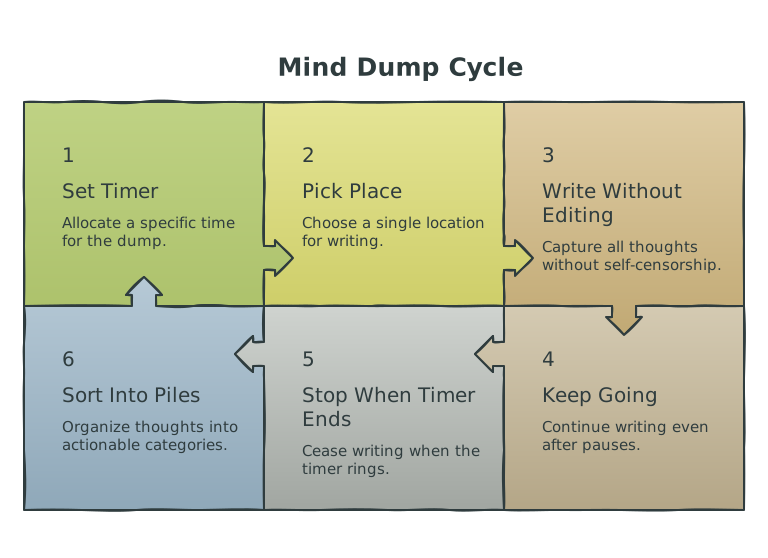
1. Set a timer. Ten minutes is a good default. Five works for a quick reset mid-task. Twenty or thirty makes sense for a first-time or quarterly deep dump. The timer matters more than the length you pick, because it keeps you moving instead of second-guessing what's worth writing down.
2. Pick one place. A notebook, a blank doc, a notes app—whatever's already within reach. The tool matters less than not switching tools mid-dump.
3. Write without editing. Tasks, worries, half-formed ideas, things you're dreading, things you're looking forward to—all of it, in whatever order it surfaces. Don't stop to categorize or judge whether something "counts." If it's taking up space in your head, it counts.
4. Keep going when it feels done too early. The first thirty seconds usually surface the loudest, most obvious items. The more interesting stuff—the thing you've been avoiding thinking about, the half-formed idea from three days ago—tends to show up once the obvious list is cleared out. Don't stop at the first pause.
5. Stop when the timer ends. Even mid-thought. You can always do another dump later. The stopping point is what signals your brain that the capture phase is over.
Only after the timer stops do you sort. Go through what you wrote and separate it into three rough piles: things that need action today, things to schedule for later, and things you can let go of entirely. Not everything on a brain dump page deserves a spot on your calendar. Some of it was just noise that needed somewhere to land. If decision fatigue is slowing you down before you even start sorting, try our 4-minute reset for decision fatigue first, then dump.
One common mistake: treating the brain dump itself as the to-do list. It isn't. A brain dump is capture. Sorting into action is a separate step that happens after, with a clearer head. If you want to go deeper on turning your dumps into actionable plans, productivity journaling is the natural next step.
Brain Dump for ADHD
Brain dumping works for anyone, but it does something more specific for ADHD brains, and it's worth understanding why.
Executive function challenges, especially around working memory and task initiation, mean that ADHD brains often can't rely on "just remembering" the way neurotypical brains can. Nothing is wrong with this. It's a structural difference, and it means external systems matter more, not less. A brain dump is one of the lowest-friction external systems available. There's no app to learn, no format to get right, no barrier between having a thought and getting it down.
ADHD minds also tend to generate a higher volume of simultaneous, competing thoughts—sometimes called "racing thoughts" or the "forty tabs open" feeling. A brain dump interrupts the loop that keeps those thoughts cycling for attention. Getting them onto paper, even in a chaotic list with no order, gives the brain permission to stop rehearsing them.
A few adjustments make brain dumping more effective specifically for ADHD (for the full walkthrough, see our ADHD brain dump guide):
- Use category prompts, not a blank page. A blank page can be paralyzing when your mind is already loud. Trigger categories—work, health, money, relationships, ideas—help pull thoughts out of hiding instead of waiting for them to surface on their own.
- Keep the timer short. Five to ten minutes works better than an open-ended session, which can spiral into overthinking or hyperfocus in the wrong direction.
- Don't skip the sort step, but don't do it the same sitting. Capture and organize are two different cognitive modes. Trying to do both at once is where a lot of ADHD brain dumps stall out.
- Make it a repeatable ritual, not a one-time fix. A single brain dump helps once. A regular practice, daily or a few times a week, prevents the backlog from rebuilding.
Brain Dump Templates
A blank page works, but a light structure helps most people get more out of the practice, especially on days when your mind feels foggy rather than loud. If you want ready-made prompts, see our collection of journal prompts for creativity and self-discovery.
Here are a few formats worth trying:
The Category Sweep
Instead of writing freely, work through a short list of life areas and jot down whatever comes up in each: work, home, health, money, relationships, ideas. This catches things a pure freewrite tends to miss, because it prompts areas you might not think to check on your own.
The Timed Sprint
Set a timer for five minutes and write continuously—no stopping, no editing, no organizing. This format is best when you're overwhelmed and need fast relief rather than a thorough sweep.
The Three-Column Dump
Divide your page into three columns: Tasks, Worries, Ideas. As thoughts come up, drop them into whichever column fits. It adds just enough structure to make sorting afterward faster, without slowing down the capture itself.
The Morning Primer
A short, five-question version done first thing, before checking your phone:
- What's on my mind?
- What am I worried about?
- What am I looking forward to?
- What's one thing I can let go of today?
- What's my one priority?
This works well as a daily habit rather than an as-needed release valve. It pairs well with a self-reflection journal practice.
The End-of-Day Close-Out
Similar structure, done before bed instead of on waking. Useful for people whose mental noise peaks at night rather than in the morning. If racing thoughts keep you up, our guide on mental clarity on demand covers additional techniques for quieting a busy mind.
Brain Dump vs Morning Pages
Brain dumping gets grouped with a handful of other journaling and productivity methods, and while they overlap, they're not interchangeable. Picking the right one for the moment makes a real difference.
A brain dump is a strategic reset. It has no rules, no required length, and no specific goal beyond getting everything out of your head. You reach for it when you're overwhelmed and need relief fast.
Morning pages, a method from Julia Cameron's The Artist's Way, is a stricter daily ritual: three full pages of longhand, stream-of-consciousness writing, done first thing in the morning, never reread. The goal isn't productivity. It's creative unblocking—working past your inner editor to access subconscious material.
Brainstorming is narrower than either. It's focused idea generation around one specific problem or project, not a general mental release. You brainstorm toward something. You brain dump away from something.
A to-do list is the organized output, not the raw input. It comes after a brain dump, not instead of one. Trying to skip straight to a to-do list without first clearing the noise tends to produce a list that's incomplete or poorly prioritized, because you're still holding half the load in your head while building it.
Journaling is the broadest category of the group, and it can include any of the above. Reflective journaling, gratitude journaling, and expressive writing all fall under it, but they typically involve more structure and slower thinking than a brain dump, which prioritizes speed and volume over depth.
For the full comparison—including when each method actually works better and why—see our guide: Brain Dump vs Morning Pages.
Where to Start
If your mind feels loud right now, don't overthink the format. Grab whatever's nearby, set a timer for five minutes, and start writing. The method matters less than starting.
Once you've cleared the noise once, the real value comes from making it a repeatable habit rather than a one-time fix. Whether that means a daily morning primer, a weekly deep sweep, or an as-needed release valve when things pile up, the goal is the same: get it out of your head and onto paper, so your mind can do what it's actually good at—thinking, not storing.
Related Articles
- Brain Dump vs Morning Pages — How brain dumping compares to Julia Cameron's morning pages, and when to reach for each one.
- Productivity Journaling — Once you've dumped, this is how you turn raw captures into an actionable system.
- 100 Brain Dump Prompts — Ten themed prompt sessions for when a blank page feels like too much.
- ADHD Brain Dump Guide — Step-by-step brain dumping built around executive function, time blindness, and thought loops.
- Bullet Journal Brain Dump — Five page layouts for doing your dump inside a bullet journal.
- Creative Brain Dump Techniques — Brain dump methods for writers and artists working through creative blocks.
- Journal Prompts for Creativity — When a blank page feels like too much, prompts give your dump a starting point.
- The 4-Minute Reset for Decision Fatigue — If decision fatigue is blocking your dump, try this breath-and-scan reset first.
- Mindfulness Journaling — A present-moment alternative when you want awareness over action.
- Why Start a Journal — 12 proven reasons journaling changes your life, starting with just one page.
- Journal vs Diary — The difference matters: understand which format serves your goals best.


